Friday, June 24, 2005

No Change


Nothing has changed;
everything has not changed.

Did I not get what I wanted, or
did I not get what I wouldn't have wanted?

Is that rationalization,
the self comforting herself?

And if so, is it self-deception, or
merely constructing a different ending?


Cassandra: Blind and Mourning from http://homepage.mac.com/cparada/GML/Cassandra.html

An MIT Survey on Blogging!

Take the MIT Weblog Survey
Doesn't take long.

Wednesday, June 22, 2005

Credo

this is an audio post - click to play

Tuesday, June 21, 2005

My Class Wiki

See the new banner one of the students made
wikibanner

Monday, May 09, 2005

Stress - Good or Just Stressed

Confusion
Why do I find it so hard to plan? I suspect that trying to plan a multi-threaded experience with all the threads in place from the beginning could be the problem.

I'm planning a course with many learning filaments woven into a complex cord that I hope leads students out of a labyrinth into an open space where they can see their own path.

Poetry may be possible again, after so many years.

Monday, March 28, 2005

Solo Images


Solo Images, originally uploaded by Semiotic Explorer.

Or to show you a larger size, as I set up another small tutorial ...

In the Halls of Academe

Solo Images

What are we selling our young? Who are we selling our young to? Is this subliminal seduction with multiple repetions of an act (a suggested act?) at the edges of consciousness - what we almost ignore?

Wednesday, March 16, 2005

Language and the Web

So I'm noticing this difference in the way my students freewrite. Freewriting is an exercise developed by Peter Elbow where you write without pausing for a timed period, not stopping to think or correct, just steadily writing. It's an exercise aimed at getting in touch with our internal flow of words, (with reference to Vygotsky).

My students not only don't have to be nagged to keep going; they have told me they like it!!!!! Very different from my experience using free writing with students 3 years ago. Plus I have noticed that none of them handed in papers that were shorter than the required 15 pages, and many, if not most, were longer! Another surprise.

After thinking and discussing it with my students, I have come to the conclusion that this is the generation that has been using web writing for social purposes, like they do for talking. They are already in touch with their inner flow of language!!!! Their connection with written language is vitally different in a significant way.

And now this Wired article with someone in Wales noticing a variation of the same thing!

This shift isn't the end of teaching writing. No more than talking precludes learning how to present. There is still much for students to learn if they want to write academic papers or business reports.

Tuesday, March 01, 2005

When is a Sick Day Not a Sick Day?

So - two days at home, one afternoon nap, two after dinner work sessions, as well as all day, both days. What is a sick day currently?
wool
And why the wool? A metaphor for learning GoLive. How does one learn a complex tool? Where does one start? What thread do I pull out the allows me to follow it into the creativity I seek?

All day, and almost nothing accomplished! Ahrggg!

Monday, February 28, 2005

Gladwell's blink


Only someone who loves reading could have drawn this Posted by Hello

I just finished reading Gladwell's blink today. What he says makes total sense to me. It's the scientific, academic information that backs up something I've been (sort of) aware of since I figured out how to write multiple choice tests in high school. I can't remember how I figured it out, but I do remember knowing that I should go with my first (instinctive?) choice, rather than thinking about it. If I thought about my answers, I got lower marks than if I just "guessed," so I "guessed." I remember feeling guilty because my friend Barb, who studied harder, I thought, and often helped me review, sometimes got lower marks. She tried too hard.

I remember reading somewhere, years ago, that if runners ran full out, and at 3/4s effort, that they often ran faster at 3/4s. Same thing, I guess.

And I really like how Gladwell writes, with information embedded in narratives, and descriptions of the people involved as researchers or as examples. He humanizes knowledge.

I was a bit disappointed that he didn't mention Michael Polyani, because I think some of the research, especially the stuff about "implicit" knowledge, was rooted in Polyani's thought.

And it is relevant to teaching. The rules about how to make an improv work were interesting, and I often think that teaching is a lot like performing an improv, and "mindreading" the student's faces to see how it's going over (or rather "in"). The part about Rip and the red and blue team, reminded me of how the rules can be used by people not in the classroom to actually diminish a teacher's skills and abilities. Some people prefer power to understanding and success.

Saturday, February 26, 2005

Wednesday, February 23, 2005

Using Picasa


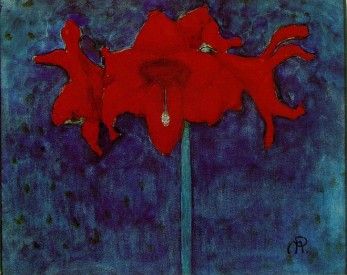
The frustration of learning relieved by beauty Posted by Hello

This picture by Mondrian was uploaded using Picasa2 and Hello.

Wednesday, February 16, 2005

PRACTICE

Here is a photo I took and, using Flickr, posted here!

My thinking tool

Sunday, February 06, 2005

Do the Tool and the Times Make a Difference?

I believe that the act of writing is changing. We have a radically new tool, no make that plural, we have radically new tools, and we think through them differently. Does anyone think we would write the same way with a quill pen as with a ballpoint pen? Does writing with a pencil change the way we write from how we would write with a fountain pen? And the big question, does writing with a word processer in an online environment change how we write?

The second question is, do we humans write the same way at different points in history? Do I write like Aphra Behn? or George Elliott? or Emily Bronte? or Virginia Woolf? or Margaret Lawrence? or Margaret Atwood? Or even in a similar style? Of course not. And are patterns in writing changing? I've read that articles in scholarly journals written in the 1930s were much denser and more formal than modern articles. And magazines are very different too. Do we even think about writing the same way as writers did then?

Now that we can write and "publish" for the world to read with no publishing "gatekeepers, now that we can write knowing our spelling mistakes will be automatically pointed out to us, and a correct possible replacement offered to us, now that we can write, and change what we've written immediately with no traces of the previous wording left, now that we live in a world with informal writing, email and messaging, for example, as well as formal business reports, do we all need to know formal stylized rhetoric of the 1960s?

Tuesday, February 01, 2005

Tuesday, January 18, 2005

Monday, December 27, 2004

Thoughts

My thinking tool
The twentieth century was a time of great expansion of representational modes. The development of photography, sound recording, moving images, movies, radio, and television has led to our culture being increasingly dominated by human-made semiotics. However, during most of the past century, the need for elaborate skills and equipment meant that cost limited authorship in these new representational modes, as it did for the more established mode of print. Despite, or perhaps because of, these gatekeepers, audiences were educated in these new representational modes simply by passive immersion. These new modes were not widely or systematically studied in how they represented (rather than simply as crafts to be learned for a limited few producers/authors) until the last quarter of the past century.

In the twenty-first century we (and our students) are in Ong’s “secondary orality” as more and more of us take in information holistically from the semiotic sea that surrounds us, rather than analytically and reflectively from printed text. At the same time, the representational gatekeepers of expensive complex equipment and skills have been largely removed. The ubiquitous computer and Web have created tools that are increasingly “affordable” and “user-friendly” which allow us (and our students) to individually create in the new representational modes developed in the twentieth century - photography, sound recording, moving images, movies, radio, and television, - as well as in the traditional alphanumeric print. And we can publish our work online to a worldwide (potential) audience.

How do we teach (and test) in this rapidly evolving semiosis? How do we shape curriculum for digital natives while we are still immigrating into the digital world ourselves? Are our students thinking and/or learning differently than we do or did? And if so, how? Is a photographic essay “equal” to a word-processed essay for teaching and/or for showing a student’s knowledge? And what about a sound and/or video documentary? Will our students learn more or more deeply from such representational modes than from text? Even if we focus exclusively on written text, as I will, what are the changes in writing brought by word-processing and the Web?

The computer is not a typewriter and the Web is not a collection of books. Teaching academic writing and business communication currently demands teaching the tool as well as the process, and teaching the visual as well as the verbal impact of structuring language. I believe we teachers of writing (and teachers using writing) must step off the dock of past practices into our digital boats and launch ourselves into this shifting semiosis.

After many years of teaching using the chalkboard and overhead, I was pushed into teaching academic writing and business communications using the computer and Web. For 10 years now I have been teaching Ontario post-secondary students, both college and university, how to communicate using the online computer – and learning from them. Since the late Nineties, I have been teaching using a Course Management System where I develop materials and then my students access them online, and in this process teach me how to teach online. In the last three years, I have seen radical changes in how the young, even the computer-reluctant young, combine writing and the computer. I have been learning about this new curricular space and how to shape it using the knowledge of the digital natives I encounter and helping those around me, whether labeled “teacher” or “student” to navigate in and through this shifting semiosis.

Monday, November 08, 2004

Not Enough Time

notime
Now, as I wait for a student who is overdue, I am grabbing some time to blog. Using Paint on the IBM the school provides for those using computers in their teaching, I give you my current descriptive image. I should be marking, but ... this is my break!

Bush, for four more years :-(

Caught between resenting the bad name being given by fundamentalists of all stripes to religion, and fear that their passion will destroy much that I value, I spend my time marking papers, fearing that my suggestions will go unheeded.

It's November. On dark days, I wilt; on sunny days, I can try to keep going.

An old poem:

November in School

In November, everything crashes -
files are lost,
cars slide into each other,
suiciding squirrels shut down generators

and I
am late for school.

In November, people weep -
assignments fail,
teachers and students snarl,
work done is less than hoped,

and more,
much more, is required.

In November, we fear -
even if Christmas ever comes,
even if spring only hides behind
the winter we have to endure,

we have lost
whatever we came here to find.

Tuesday, October 19, 2004

Time Flies


Time flies when I have taken on a lot of work. On the one hand I love teaching. On the other, marking is a part of teaching.

I had a wonderful rant yesterday. I was lecturing on how literacy has changed our very way of being in the world, the way our psychology is shaped. I was charged up with my understanding of Ong and Havelock and a rich sense of what they meant and I flowered into the moment and engaged the students.

I've felt this before; it is the sweet moment of teaching/learning. I can reach them, hold them, and then release us from a kind of electric exchange. It is what I felt when I "saw" the golden chords reaching from my fingers and touching the students when I taught English as a Second Language in the top floor of a converted warehouse. It is what I experienced in some of my poetry classes. It has been rare for me lately as I struggled mired in enmeshing change. I love it, but I can only prepare for it; i can't command it.

It is something to do with oral rhetoric. It is a moment of wholeness and fullness. It is a psychic embrace. I am grateful for the moment and the experience. I hope they are too.

Tuesday, September 21, 2004

Windows xp Ate My Files

Good thing I kept my backup CD and it wasn't too out-of-date. Today, in class, as I tried to show my class that you have to be careful where you save your files, I was surprised to discover that my largest, most important folder had simply disappeared from 'My Documents" and all the other folders were shortcuts. "Search" didn't find my lost folder for me.

When I went to the technicians, they muttered that xp hade done this to others too!!!!! They found some of my missing folders, but not all of my files. My backup CD helped, but this leaves me scared. Obviously I can't save anything important and back it up on my IBM; it simply can't be trusted.